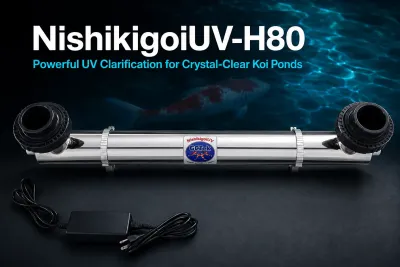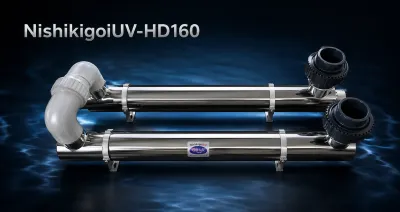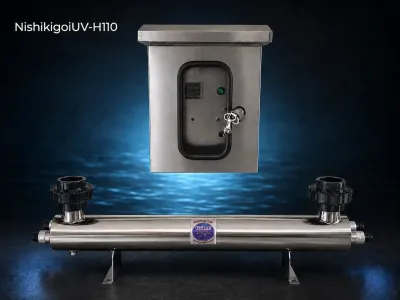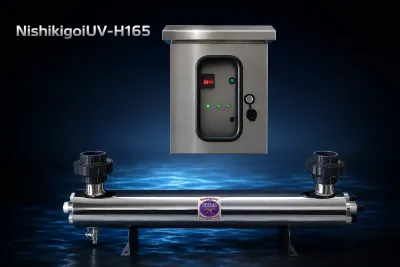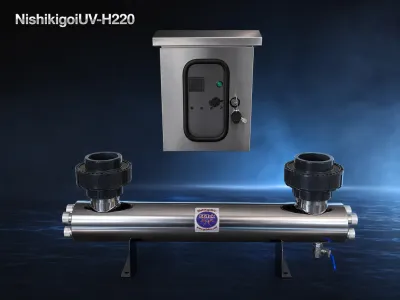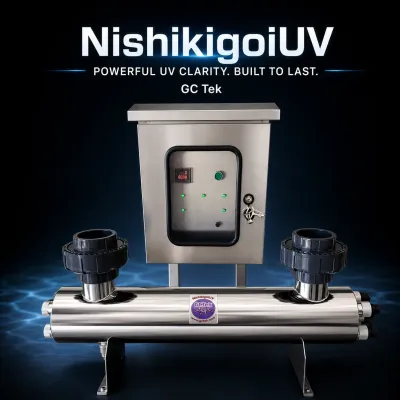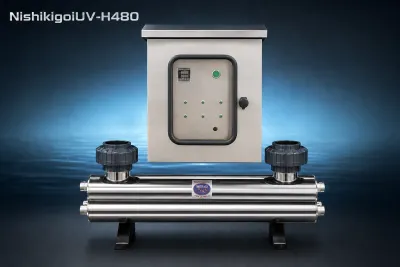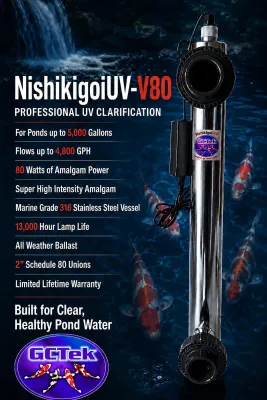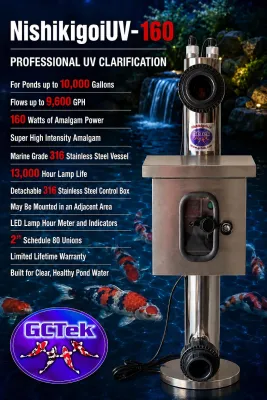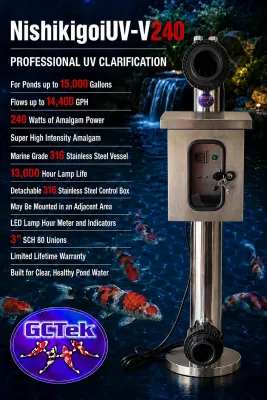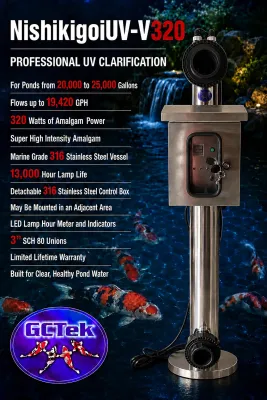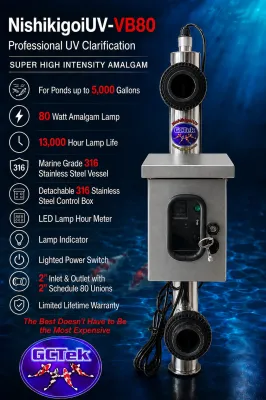
NishikigoiUV-VB80. 316 Stainless Steel Unit with Detachable Stainless Steel Weather Proof Control Box.
Shop Now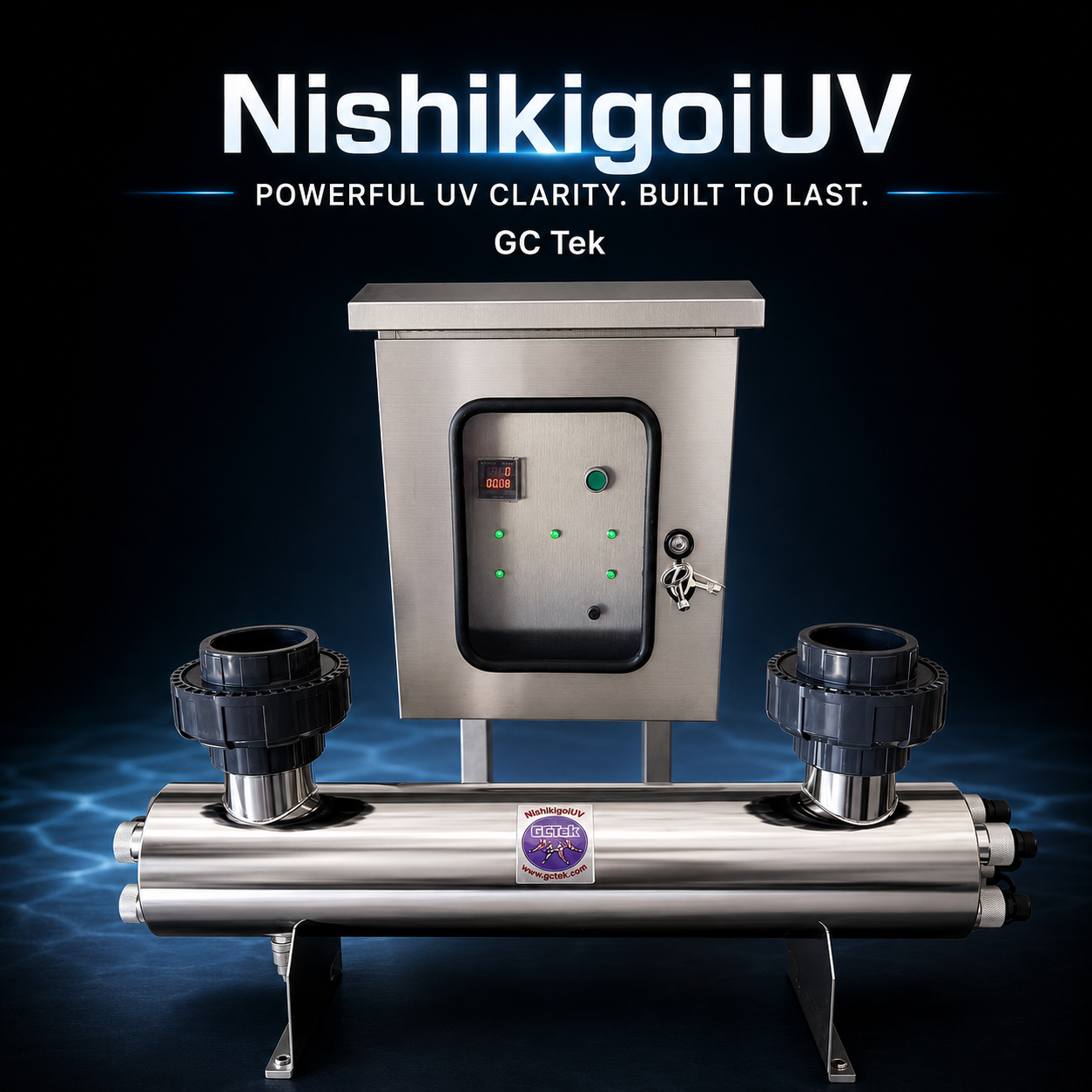
Clear koi pond water is about more than appearance. Good visibility makes it easier to appreciate the colors and patterns of your koi, monitor their condition, and identify changes in the pond. However, even a well-maintained pond filtration system can struggle with green water when free-floating algae multiply faster than conventional filtration can remove them. A pond UV clarifier adds another level of water treatment by exposing circulating pond water to ultraviolet light. NishikigoiUV systems from GC Tek are designed for demanding koi ponds and professional filtration systems, combining high-output amalgam UV technology with durable construction and practical controls.
With models ranging from 80 to 480 watts, the NishikigoiUV range gives pond owners and professional installers multiple options for different pond volumes, flow rates, sunlight exposure, fish loads, and filtration requirements.
Mechanical and biological filtration perform essential jobs in a koi pond, but neither is specifically designed to address every cause of green water. Free-floating microscopic algae can remain suspended in the water and reproduce rapidly, particularly when sunlight and nutrients are readily available. A UV clarifier treats the water as it circulates through a chamber containing a UV lamp. The ultraviolet exposure targets free-floating algae responsible for green water. The affected algae can then be captured more effectively by the pond's mechanical filtration.
This is why a UV unit should generally be viewed as part of a complete filtration process rather than as a replacement for a pond filter. Mechanical filtration removes physical waste and suspended material. Biological filtration supports beneficial bacteria involved in processing fish waste. UV clarification targets suspended algae. When appropriately selected and integrated, these different stages work together to maintain clearer pond water.
NishikigoiUV systems use high-output amalgam lamp technology to produce strong and consistent ultraviolet intensity. This makes the range suitable for koi ponds where dependable clarification and substantial water circulation are important. As pond water moves through the UV chamber, free-floating algae are exposed to ultraviolet energy. The treated material can subsequently be removed through the mechanical filtration process, helping restore the water clarity needed to see koi more clearly.
The effectiveness of UV treatment, however, depends on more than lamp wattage. The volume of water passing through the chamber, the condition of the water entering the unit, lamp performance, pond turnover, and the overall filtration configuration can all influence results. For this reason, a properly selected UV clarifier should be matched to the complete pond system rather than chosen on wattage alone.
The NishikigoiUV range extends from 80W to 480W, providing options for different pond and filtration requirements.
Available models include:
| NishikigoiUV Model | UV Output |
|---|---|
| NishikigoiUV-H80 | 80W |
| NishikigoiUV-H110 | 110W |
| NishikigoiUV-H160 | 165W |
| NishikigoiUV-H220 | 220W |
| NishikigoiUV-H400 | 400W |
| NishikigoiUV-H480 | 480W |
| NishikigoiUV-V80 | 80W |
| NishikigoiUV-VB80 | 80W |
| NishikigoiUV-V160 | 160W |
| NishikigoiUV-V240 | 240W |
| NishikigoiUV-V320 | 320W |
The appropriate model should not be selected simply by choosing a wattage based on pond gallons. Pond volume is an important starting point, but actual water flow, sunlight exposure, existing water clarity, plumbing arrangement, fish load, filtration performance, and the desired level of UV treatment should also be considered. Large or heavily stocked koi ponds can have very different requirements from lightly stocked ornamental ponds of similar volume. Professional guidance is therefore valuable when determining the appropriate NishikigoiUV model and installation configuration.
There is no single UV wattage that is appropriate for every pond of a particular gallon capacity. Two ponds containing the same volume of water may have different UV requirements because one receives full sunlight while the other is shaded. One may contain a substantial koi population and receive heavy feeding, while the other has relatively few fish. Their circulation rates and existing mechanical filtration may also be completely different.
When sizing a UV clarifier for a koi pond, consider:
The goal is to provide appropriate UV exposure while maintaining suitable circulation through the complete pond system. Choosing solely according to the highest available wattage does not necessarily produce the best system design.
Flow rate is one of the most important considerations when integrating UV equipment into a pond filtration system. The water needs to pass through the UV chamber under conditions that allow the unit to provide the intended treatment. Actual flow through the installed system can be different from the maximum GPH printed on a pump specification because pipe diameter, plumbing length, fittings, valves, elevation changes, filters, and other equipment create resistance.
This means UV selection should consider real operating flow, not simply the pump's advertised maximum output. The UV unit also needs to work as part of the pond's overall turnover and filtration strategy. If circulation leaves significant areas of the pond poorly served, improving the UV unit alone may not address the underlying water-clarity problem. A properly designed system therefore considers the pump, plumbing, filtration and UV equipment together.
A premium pond UV system should be capable of providing dependable service in demanding filtration environments. NishikigoiUV vessels are manufactured from marine-grade 316 stainless steel, providing corrosion resistance, strength, and long-term durability. This construction differentiates the system from units built primarily around ordinary plastic or lower-grade stainless-steel vessels. The polished stainless-steel chamber also helps reflect UV energy within the vessel, making efficient use of the lamp's output. The NishikigoiUV vessel is backed by a lifetime warranty, excluding rubber components, providing additional confidence for pond owners investing in long-term filtration equipment.
Lamp performance is another important consideration when choosing a pond UV clarifier. NishikigoiUV amalgam lamps are rated for approximately 13,000 operating hours, compared with the 9,000-hour rating commonly associated with many conventional UV lamps. Longer lamp life can mean fewer replacements and less routine servicing over the life of the system. Depending on the model, NishikigoiUV systems contain between one and six lamps. On multi-lamp systems, individual ballasts allow the remaining lamps to continue operating if one lamp or ballast requires attention. This can be particularly useful in larger koi ponds, heavily stocked systems, and professional installations where maintaining UV operation is important.
Lamp age should still be monitored. A UV lamp can continue producing visible light even when its useful UV output has declined, which is why operating hours provide valuable maintenance information.
Most NishikigoiUV models include a separate weather-resistant stainless-steel control box designed to make system monitoring and servicing more convenient. Built-in lamp indicators allow pond owners to check lamp operation at a glance. An hour meter records operating time, helping owners determine when lamp replacement should be considered rather than relying on guesswork.
Individual lamp ballasts on applicable multi-lamp units also simplify servicing and provide additional operational flexibility. These features become particularly valuable on large ponds and professional filtration systems where a UV problem may otherwise go unnoticed until water clarity begins to deteriorate.
The ideal placement of a UV clarifier depends on the pond’s filtration design, pump configuration, plumbing, and the specifications of the UV unit. In most systems, UV clarification works as one stage of a broader filtration process rather than as a standalone treatment. Pond water should first move through the appropriate solids removal and filtration stages before UV treatment. Allowing cleaner water to enter the UV chamber can support more effective UV exposure by reducing the amount of suspended debris passing through the unit. After UV treatment, the water can continue through the system and return to the pond.
The exact position can vary depending on whether the pond uses a gravity-fed or pump-fed configuration and how the mechanical and biological filtration components are arranged. For this reason, the UV clarifier should be installed according to the requirements of the selected unit and the overall pond filtration design.
Installing UV equipment does not guarantee that every green-water problem will disappear immediately. If green water persists, the complete system should be checked before assuming the UV unit is inadequate. One potential cause is incorrect sizing. The UV output may not be appropriately matched to the pond conditions and actual water flow. Excessive flow through the unit can also affect the amount of UV exposure received by the circulating water. Lamp condition should be checked as well. UV output decreases with operating time, so an older lamp may continue to illuminate while no longer delivering its original treatment performance.
Other factors can include poor circulation, heavy algae conditions, inadequate mechanical filtration, a dirty UV-related component requiring maintenance, or a problem with the lamp or ballast. Persistent green water should therefore be diagnosed systematically. Check the UV equipment, flow, filtration and pond conditions together rather than immediately replacing the unit with a larger model.
One of the most important distinctions for pond owners is the difference between UV clarification and pond filtration. A UV clarifier is not intended to perform all of the functions of a koi pond filter. Mechanical filtration captures physical waste and suspended debris. Biological filtration provides an environment for beneficial bacteria that help process waste generated by fish and decomposing organic material. UV treatment primarily addresses free-floating organisms such as the algae associated with green pond water.
For a koi pond, these processes complement one another. If a pond contains large quantities of bottom waste, an ammonia problem, poor circulation, or an overloaded mechanical filter, adding more UV power does not correct those underlying problems. Similarly, an effective mechanical and biological filter may still require UV assistance when suspended algae are affecting water clarity. The strongest results come from treating the pond as a complete system.
Routine maintenance helps preserve the performance of any pond UV system. Operating hours should be monitored so lamp replacement can be planned according to the recommended service interval. Lamp-operation indicators should also be checked periodically rather than waiting for water clarity to deteriorate. UV components exposed to pond water should be inspected and maintained according to manufacturer recommendations. Any buildup that interferes with UV transmission can potentially reduce treatment effectiveness.
Pond owners should also continue maintaining the rest of the filtration system. A clean UV unit cannot compensate for a severely restricted filter, inadequate circulation, or excessive organic waste elsewhere in the pond. Looking after the complete filtration chain helps the UV equipment perform the specific job it was designed to do.
NishikigoiUV systems combine high-output UV technology with features intended for demanding koi pond applications:
The broad model range also allows UV capacity to be selected according to the requirements of the pond rather than relying on a single unit for widely different applications.
For serious koi ponds, water clarity and quality depend on several filtration processes working together. Effective circulation moves water and waste through the system, while mechanical filtration removes suspended solids, biological filtration supports beneficial bacteria, and UV clarification helps control the free-floating algae responsible for green water. NishikigoiUV can work alongside other GC Tek filtration equipment to create a more complete pond treatment system. NishikigoiRDF Drum Filters provide mechanical prefiltration by removing suspended solids and debris from the water, while NishikigoiWakimizu filtration systems add biological filtration capacity to support water quality in demanding koi ponds. NishikigoiUV complements these stages by providing dedicated UV clarification.
This approach is suitable for both new pond builds and existing systems that need additional filtration or clarification. Rather than selecting each component in isolation, pond owners should consider pond volume, fish load, actual flow rate, plumbing, mechanical filtration, biological filtration, and UV requirements together. Matching these components helps create a more balanced filtration system while making it easier to address solids, biological waste, and green water at the appropriate treatment stage.
Koi are often called living jewels, and clear water allows their colors, patterns, movement, and condition to be seen properly. Persistent green water can hide that beauty even when considerable effort has gone into the rest of the pond. NishikigoiUV combines powerful amalgam UV technology, marine-grade 316 stainless-steel construction, long lamp life, and practical monitoring controls to provide dependable clarification for serious koi ponds.
Whether you are designing a new filtration system or adding UV treatment to an existing pond, GC Tek offers NishikigoiUV models from 80 to 480 watts to accommodate a range of filtration requirements. Selecting the correct unit according to pond volume, actual water flow, system design, and pond conditions is the key to getting the intended performance.
1. What does a UV clarifier do in a koi pond?
A UV clarifier exposes circulating pond water to ultraviolet light, targeting the free-floating algae associated with green pond water. Once affected, this material can be removed through the pond's filtration process more effectively. UV clarification works alongside mechanical and biological filtration rather than replacing either one.
2. What size UV clarifier do I need for my koi pond?
The appropriate size depends on more than pond gallons. Pond volume, actual water flow through the UV, sunlight exposure, algae conditions, fish load, turnover rate, plumbing, and existing filtration should all be considered. NishikigoiUV models range from 80 to 480 watts, allowing the system to be matched more closely to different applications.
3. How many watts of UV does a koi pond need?
There is no universal watt-per-gallon figure that is appropriate for every koi pond. A heavily stocked pond in direct sunlight may have different requirements from a shaded pond of identical volume. UV wattage should therefore be selected according to the complete operating conditions and the manufacturer's sizing recommendations.
4. Will a UV clarifier get rid of green pond water?
A properly selected and functioning UV clarifier can help control the free-floating algae responsible for green water. Results also depend on flow, circulation, lamp condition and filtration. If green water persists, the entire system should be inspected rather than assuming more UV wattage is automatically required.
5. Does a UV clarifier replace a koi pond filter?
No. They perform different jobs. Mechanical filtration removes physical waste, biological filtration supports bacteria involved in processing fish waste, and UV clarification targets free-floating algae. A well-designed koi pond can use these processes together to support both water clarity and overall water quality.
6. How long do NishikigoiUV lamps last?
According to the supplied NishikigoiUV specifications, the amalgam lamps are rated for approximately 13,000 operating hours. Monitoring operating time is important because a lamp can continue producing visible light even as its effective UV output declines.
7. Why is my pond still green when the UV light is working?
Possible causes include inappropriate UV sizing, excessive water flow, an aging lamp, maintenance requirements, poor pond circulation, heavy algae conditions, or inadequate filtration. The presence of visible light from the lamp alone does not necessarily confirm that it is still producing its original UV output.
8. Should a pond UV clarifier run continuously?
Operating requirements depend on the pond, season, equipment, and treatment objective. During periods when continuous clarification is required, UV units are commonly incorporated into the pond's circulating filtration system. Follow the manufacturer's operating recommendations for the selected NishikigoiUV model.
9. How often should a pond UV system be maintained?
Maintenance should be based on operating hours, water conditions, and the manufacturer's recommendations. Lamp condition, indicators, and components affecting UV transmission should be inspected periodically. The surrounding mechanical filtration should also be maintained so excessive waste does not compromise overall system performance.
10. Is a stainless-steel UV clarifier suitable for a large koi pond?
Stainless-steel construction can provide strength and corrosion resistance for demanding filtration environments. NishikigoiUV uses marine-grade 316 stainless-steel vessels and offers models ranging from 80W to 480W, allowing pond owners and installers to select among multiple capacities for different pond systems.