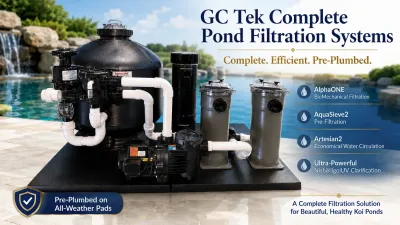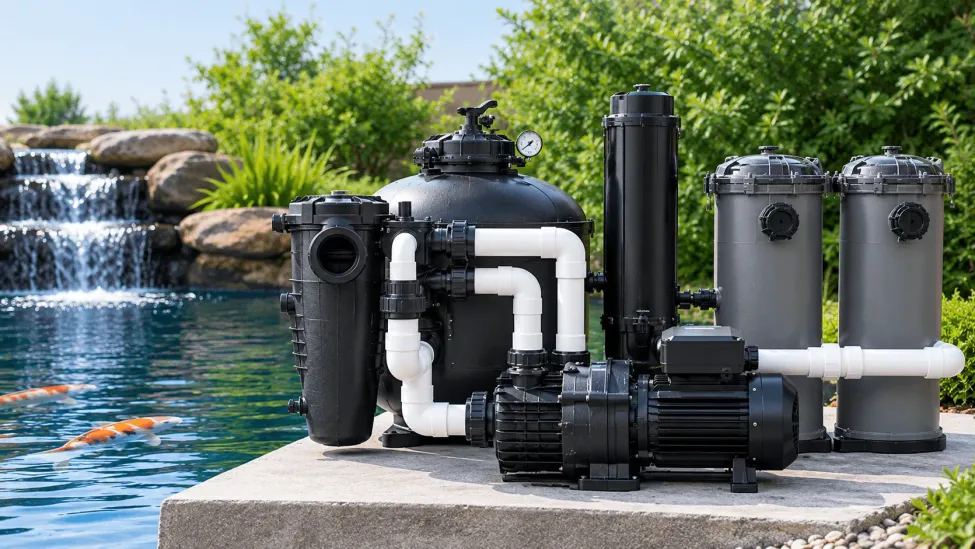
A pond pump is designed to circulate water through your pond and filtration system, but the amount of water it actually moves depends on how it is installed. For example, a pump advertised to deliver 7,000 gallons per hour (GPH) may move only around 4,000 GPH when connected to a bead filter, a UV clarifier, and 60 feet of pipe. This happens because the water encounters resistance as it passes through the pipes and equipment, while the pump may also need to push water to a higher elevation. This resistance is known as pond pump head loss. It does not necessarily mean the pump is faulty; it simply means the pump has to work harder to move water through the system.
Understanding head loss is important because it affects how efficiently water circulates through your pond and how well your filtration system performs. A pump that delivers less water than expected may not provide the required water turnover for your koi pond. To choose the right pump and get the best performance, you need to understand how pipe length, pipe diameter, bends, filters, and elevation affect water flow. This guide explains how head loss occurs, how to calculate the total dynamic head of your pond system, how to read a pump performance curve, and how to improve your plumbing setup to maintain better water flow. All calculations use US measurements, including feet of head and gallons per hour (GPH).
Pond pump head height is the energy a pump adds to water, expressed as the height of a water column it could support. Pump makers use feet (or meters) of head because it stays the same regardless of the fluid's pressure units, and because it maps directly onto what a pond owner can measure with a tape.
The resistance your pump works against is called total dynamic head (TDH), and it has three parts:
So: TDH = static head + friction head + equipment head.
There is also velocity head, the energy carried by moving water as it exits the pipe. At the 3 to 6 ft/s velocities typical of well-sized pond plumbing it amounts to roughly 0.1 to 0.6 ft, so most pond calculations fold it into the friction estimate or ignore it.
The important distinction is that static head is fixed by your layout, while friction and equipment head are "dynamic": they depend on how much water you push. Double the flow through the same pipe and friction loss rises by roughly 3.6 times. That nonlinear behavior is why bolting a bigger pump onto undersized plumbing often produces a disappointing gain.
Pipe friction comes down to four variables: flow rate, inside diameter, length and wall roughness. Diameter dominates. In the Hazen-Williams equation used across the water industry, friction loss scales with flow to the power of 1.85 and with inside diameter to the power of minus 4.87. Halve the diameter at the same flow and friction rises by roughly 29 times.
For smooth PVC the Hazen-Williams roughness coefficient is 150, a conservative design value backed by industry lab and field testing. Using that coefficient and Schedule 40 inside diameters, here is the friction loss per 100 ft of straight pipe at common pond flows, with velocity in brackets.
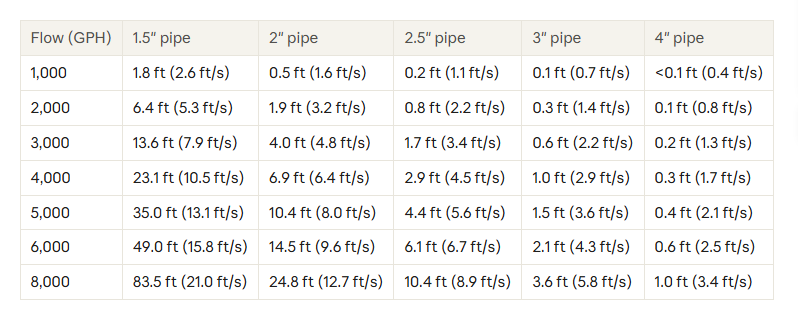
Head loss per 100 ft of Schedule 40 PVC, calculated with Hazen-Williams, C = 150.
Three things stand out:
One trap catches a lot of upgrades: matching pipe size to the pump's outlet. A pump with a 1.5" discharge does not mean the system wants 1.5" pipe. Bush up to a larger pipe right at the pump and run the larger size for the full length.
Every change of direction, size or obstruction adds turbulence, and turbulence costs head. Engineers call these "minor losses", but on a compact pond system with a short pipe run they are often the largest share of friction. The simplest way to account for them is the equivalent length method: each fitting is treated as an extra length of straight pipe, then added to the real pipe length before you apply the friction table above.
|
Fitting |
1.5" |
2" |
2.5" |
3" |
4" |
|---|---|---|---|---|---|
|
90 degree elbow |
4.0 ft |
5.2 ft |
6.2 ft |
7.7 ft |
10.1 ft |
|
45 degree elbow or long sweep 90 |
2.2 ft |
2.8 ft |
3.3 ft |
4.1 ft |
5.1 ft |
|
Tee, flow through the run |
2.7 ft |
3.5 ft |
4.1 ft |
5.1 ft |
6.7 ft |
|
Tee, flow through the branch |
8.1 ft |
10.3 ft |
12.3 ft |
16.3 ft |
20.1 ft |
|
Gate valve, fully open |
1.1 ft |
1.4 ft |
1.7 ft |
2.0 ft |
2.7 ft |
|
Male or female adapter |
3.5 ft |
4.5 ft |
5.5 ft |
6.5 ft |
9.0 ft |
Equivalent length of straight pipe per fitting, from standard published PVC fitting data.
A few practical points follow from these numbers:
Pressurized bead filters, UV clarifiers, pre-filters and spray bars usually publish a pressure drop in PSI at a given flow. Convert it to feet by multiplying by 2.31. A filter listed at 3 PSI adds about 6.9 ft to your TDH. With a bead filter, that figure is not fixed. Pressure drop is lowest just after a backwash and climbs as the bead bed captures solids and biofilm builds. This is the reason a pressure gauge on the filter inlet is worth fitting: a rising reading is both your backwash signal and a direct measure of how much flow the pump is losing between cleanings. When you size a pump for a pressurized filter, size it for the loaded condition, not the freshly cleaned one.
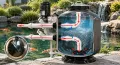
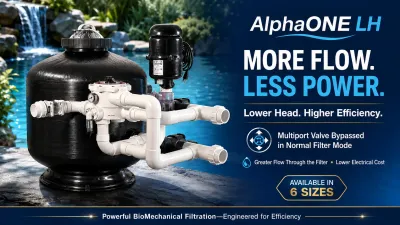
Filter design itself also affects this number. GC TEK's AquaBead LH filters (LH stands for "Lower Head") are built with a low-restriction valve assembly, so the filter takes less head out of the system and the pump moves more water for the same power. On a high-head system, that can be the difference between keeping your current pump and buying a bigger one. Automating the backwash, for example with GC TEK's TheLiberator valve, keeps the filter closer to its clean pressure drop for more of the week.
On the suction side, the bottom drain, skimmer and any pre-filter or strainer basket also add loss. With a submersible pump these are mostly irrelevant. With an external pump they matter more, because suction-side losses reduce the pressure available at the impeller inlet. We come back to this under pump types below.
A pond pump curve shows how much water a pump moves at each height of head. A pump's flow is not a fixed number. It is a curve. Every centrifugal pond pump, submersible or external, produces high flow at low head and less flow as head rises, until it reaches shut-off head, the point where it spins but moves no water. The headline GPH on the box is the opposite end of that curve: maximum flow at zero head. Your plumbing has a curve too. The system curve starts at your static head (at zero flow, the pump still has to lift water to the discharge height) and bends upward as flow increases, because friction and equipment losses grow roughly with the square of flow.
The pump does not get to choose where it runs. It settles at the operating point, the flow where the pump curve and the system curve cross. Change the system (bigger pipe, fewer elbows, a dirty filter, a half-closed valve) and the system curve moves, taking the operating point with it.
Three markers on a manufacturer's curve deserve attention:
In practice, this means you should not choose a pump by its headline GPH, and you should not choose it by its max head either. Choose it by the flow it delivers at your calculated TDH, and check that this flow sits in the middle third of the curve rather than at either end.
If the published curve shows a wattage line, read that too. Pump input power is proportional to flow times head divided by efficiency, so two pumps that deliver the same GPH at your TDH can draw very different power depending on where that point sits relative to each pump's BEP.
Here is how the numbers come together on a common setup. The target is 4,000 GPH of turnover through a pressurized bead filter and UV clarifier.
TDH at 4,000 GPH with a freshly backwashed filter:
|
Component |
Calculation |
Head (ft) |
|---|---|---|
|
Static head |
Return 2 ft above water surface |
2.0 |
|
Suction pipe, 2.5" |
(10 ft + 2 x 6.2 ft) x 2.9 ft per 100 ft |
0.6 |
|
Return pipe, 2" |
(60 + 8 x 5.2 + 2 x 1.4 + 4 x 4.5 ft) x 6.9 ft per 100 ft |
8.4 |
|
Bead filter, clean |
3 PSI x 2.31 |
6.9 |
|
UV clarifier |
1 PSI x 2.31 |
2.3 |
|
Total dynamic head |
|
20.2 |
Now put that system against a hypothetical pump sold as "7,000 GPH" with a 30 ft max head. The chart plots its curve against four versions of the same pond: the baseline above, the same plumbing with a loaded filter, and the return line one size smaller and one size larger.
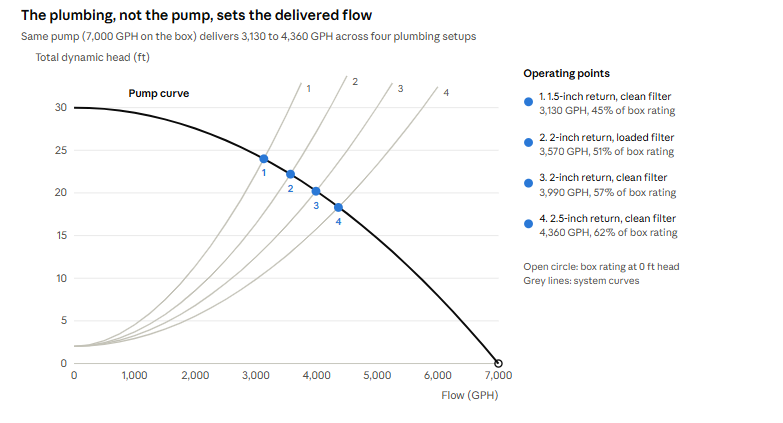
Several things show up that a box rating never would. The baseline lands close to the 4,000 GPH target, but at only a little over half the box figure. A loaded bead filter moves the operating point left until the next backwash, which is why the pump should be sized for the dirty condition. And the return line size swings delivered flow more than any filter condition does: the 1.5" version falls well short of the target, while 2.5" pipe recovers several hundred GPH at no extra running cost. Notice also that every operating point sits in the middle of the pump curve. If the plumbing had pushed it to the far left near max head, the right move would be a stronger pump. Here, the right move is better plumbing.
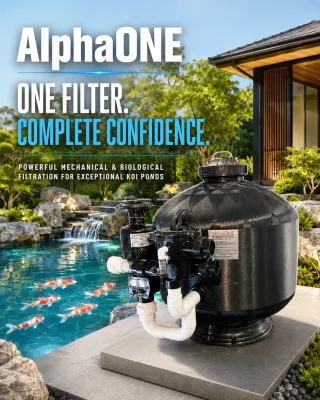
For reference, a 4,000 GPH target on a pond of this size points to a filter like the AquaBead 2.50, which GC TEK rates at 70 gpm (4,200 GPH) for ponds up to 5,000 gallons. Filter flow ratings and fish loads for every model are listed on the AquaBead sizing information page.
Pond pumps fall into a few broad groups, and their curve shapes respond very differently to head.
Low-head, high-flow pumps. Most mag-drive and many asynchronous submersible pumps are built for waterfalls and gravity-return filters: big flow at a few feet of head, then a steep fall-off. Their curves are often nearly flat at the top and drop quickly past 8 to 12 ft. They are efficient in the job they are designed for, but they are usually a poor match for a pressurized bead filter plus UV, where TDH commonly lands in the 15 to 25 ft range.
Pressure-rated external pumps. Direct-drive external centrifugal pumps, the type used on most bead filter systems, hold their flow better as head rises. The trade-off is that they need dry, ventilated mounting and correct suction plumbing.
Within this group, curve shape still varies. High head models such as the PerformancePro Artesian2 HH hold flow against higher TDH, which suits long runs and pressurized filter plus UV setups. High flow models favor volume at lower head, and low RPM models trade some peak output for lower power draw. Match the curve family to your calculated TDH, not to the largest GPH figure. The full range is on our pond pumps page.
Variable-speed pumps. These let you move the pump curve instead of living with the one you bought. The pump affinity laws state that flow changes in proportion to speed, head with the square of speed, and power with the cube of speed. In a pond with little static head, dropping speed by 20 percent can cut power draw by close to half while still giving 80 percent of the flow. The saving is smaller where static head is a large share of TDH, because the pump must still clear that lift at any speed.
GC TEK's WunderMax variable speed pump works this way: size it to deliver your target flow with the bead filter loaded, then turn it down while the filter is clean.
With an external pump, head loss on the inlet side does more than reduce flow. It lowers the pressure at the impeller eye. If that pressure drops far enough, water flashes into vapor bubbles that collapse violently against the impeller. That is cavitation, and it sounds like gravel rattling inside the pump. Every pump curve with an NPSHR (net positive suction head required) line is telling you how much inlet pressure the pump needs at each flow.
Pond keepers rarely need to calculate NPSH formally, but the same rules prevent trouble:
A self-cleaning screen ahead of the pump, such as an AquaSieve2 strainer, keeps large debris out of the pump basket so the suction side stays open between cleanings.
The hydraulic power a pump delivers equals flow times head. Using the standard pump power equation, 4,000 GPH (66.7 gpm) at 20 ft of TDH is about 0.34 hp, roughly 250 watts of work done on the water. Divide by the pump's wire-to-water efficiency and you have the electrical draw. Every foot of avoidable friction head is work the motor does 24 hours a day, 365 days a year, for no benefit to the fish. On a system running year round, a few feet of head saved through better plumbing adds up to a meaningful reduction in annual energy use.
Static head is set by your layout, but a large share of friction head is avoidable. These are the changes that recover the most flow for the least effort, roughly in order of impact.
One caution: After upgrading plumbing, a pump that was previously held back by high TDH can slide toward the right end of its curve, toward runout. Check the new operating point against the curve. If it now sits well past BEP, a smaller pump or a variable-speed model running slower may be the better choice.
A pond pump's real performance is set by the system it is plumbed into, not by the number on the box. Calculate TDH before you buy: measure static head, total the pipe and fitting equivalent lengths, add the filter and UV pressure drop at its loaded value, then read the pump curve at that head. Pick a pump that delivers your target flow there, near the middle of its curve. If you are upgrading, look at the plumbing before the pump. A larger return line, sweeping bends and a clean, regularly backwashed bead filter often recover more flow than a bigger motor, and they keep recovering it every hour the system runs.
When you pair a pump with a GC TEK AquaBead filter, start with the filter's rated flow range, plan your plumbing around it, and choose the pump last. If head is already tight, look at the AquaBead LH range first. That order gives you the flow your filtration needs at the lowest running cost.
Friction figures are calculated with the Hazen-Williams equation (C = 150, Schedule 40 PVC). The pump curve and equipment pressure drops in the worked example are illustrative, not taken from a specific product.
1. Why does my pump deliver so much less than its rated GPH?
The rated GPH is measured at zero head. Once you add lift, pipe, fittings and a filter, the pump moves left along its curve. On a pressurized bead filter system, delivered flow of 50 to 65 percent of the box rating is common, as the worked example above shows.
2. Is max head the height a pump can lift water to?
Only in the sense that it can hold a column of water at that height with zero flow. At max head the pump moves nothing. For useful flow, your TDH should sit well below the max head figure, ideally in the middle third of the curve.
3. How do I measure my actual TDH on an existing pond?
Fit a pressure gauge on the pump discharge. Multiply the reading in PSI by 2.31 to get feet of head at that point, then add the vertical distance from the pond surface to the gauge if the gauge sits above water level. Compare that number to the pump curve to find your real operating flow.
4. Does a bigger pump fix low flow?
Sometimes, but not efficiently. Friction rises with roughly the 1.85 power of flow, so pushing more water through the same small pipe gets expensive fast. Upsizing the plumbing usually recovers more flow per dollar and keeps running costs down.
5. Does head loss through a bead filter change over time?
Yes. It is lowest right after a backwash and rises as the bead bed loads with solids and biofilm. Size the pump for the loaded condition, and use an inlet pressure gauge to time backwashes.
6. Should the suction line be bigger than the discharge line?
For external pumps, yes. A larger, shorter suction line keeps inlet velocity low, protects against cavitation and lets the pump perform as its curve says it should.
7. What size pond pump do I need for a bead filter?
Pick a pump that delivers the filter's recommended flow at your calculated total dynamic head, with the filter in its loaded condition. Pressurized bead filter systems with UV often land at 15 to 25 ft of TDH, so a pressure-rated external pump is usually the right type. Check the filter's rated flow first, then read pump curves at your TDH.
8. Does pipe size affect pond pump flow?
Yes, more than almost anything else in the system. At 4,000 GPH, 2" PVC loses about 6.9 ft of head per 100 ft, while 2.5" loses about 2.9 ft. In the worked example above, the same pump delivers roughly 3,130 GPH through a 1.5" return and 4,360 GPH through a 2.5" return.
9. How do I convert PSI to feet of head?
Multiply PSI by 2.31. A filter or UV clarifier listed at 3 PSI adds about 6.9 ft to your total dynamic head.
10. How many feet of head does a UV clarifier add?
It depends on the unit and the flow through it. Take the pressure drop from the manufacturer's spec at your flow rate and multiply by 2.31. A unit listed at 1 PSI adds about 2.3 ft. Plumb UV clarifiers with full-size fittings so the connections do not add more loss than the unit itself.