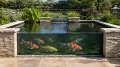
Quick answer: A koi pond should be at least 3 feet (about 90 cm) deep, while a depth of 4 to 6 feet (1.2 to 1.8 m) is generally recommended for healthy adult koi. The pond should also hold a minimum of 1,000 gallons (about 3,800 litres) of water, with a common stocking guideline of around 250 gallons of water per adult koi when the pond is supported by properly sized filtration. Koi are not small garden fish. A healthy koi can grow to 24 to 36 inches long, live for 25 years or more, and produce considerably more waste than goldfish and many other common pond species. As a result, a pond that may work well for goldfish can quickly become overcrowded, cloudy, and unhealthy as koi grow.
Getting the depth and overall size right during the planning stage is much easier than trying to correct these issues after construction. In this guide, we will look at how deep a koi pond should be, how many gallons of water you need per fish, how to calculate your pond volume, and how to choose the right filtration system so your pond remains clear, healthy, and stable throughout the year.
The depth and volume of a koi pond influence almost every aspect of the pond environment, including water temperature, oxygen levels, fish health, water quality, and filtration requirements. When a pond is too shallow or too small, koi can remain under unnecessary stress even when the water appears clean and clear on the surface.
Most koi purchased at 4 to 6 inches can grow to 18 to 24 inches within a few years, while many eventually reach 30 inches or more. Certain Japanese bloodlines, often referred to as jumbo koi, can even exceed 36 inches. For this reason, your pond should always be planned around the adult size of the fish rather than the size they are when you first purchase them.
Koi also require enough room to swim comfortably. They are active fish that naturally move through the full length and depth of their environment. When they are kept in cramped conditions, limited swimming space can contribute to stunted growth, poor body shape, and increased stress.
Pond depth and volume also play an important role in keeping water temperatures stable. A larger, deeper body of water heats up and cools down much more slowly than a small, shallow pond. This is particularly important because koi are cold-blooded fish, meaning sudden changes in water temperature can place stress on their bodies and weaken their immune response.
During summer, deeper water remains cooler and provides koi with a place to move away from excessive heat. It can also help maintain better dissolved oxygen levels when combined with proper aeration. During winter, the deeper sections of the pond remain warmer than the surface, allowing koi to move toward the bottom and rest there while the upper layer becomes very cold or freezes.
Depth is also important when protecting koi from predators. Herons, raccoons, cats, and other animals can easily access shallow ponds and make the fish easy targets. A heron, for example, can stand in approximately 12 to 18 inches of water, meaning a pond with large shallow areas can effectively become an easy feeding location.
A deeper pond gives koi somewhere to retreat when they sense danger. In addition, steep sides make it more difficult for wading birds and land-based predators to reach the fish.
Koi consume a significant amount of food and consequently produce a substantial amount of waste. As this waste breaks down, it contributes to ammonia and nitrite levels in the water. In a small pond, these compounds can accumulate quickly and may reach harmful concentrations, particularly when the pond is heavily stocked or filtration is not adequate.
A larger volume of water provides greater dilution and creates a larger buffer against problems such as overfeeding, temporary filtration issues, or short filter outages. Although larger ponds generally require more investment to build, they are typically more stable and easier to manage than small ponds.
A koi pond should contain at least 1,000 gallons of water, with around 250 gallons per adult koi being a common starting guideline. However, larger ponds are generally easier to keep stable because additional water volume provides more room for fish growth, greater dilution of waste, and a larger margin for management mistakes.
The widely accepted minimum volume for a koi pond is 1,000 gallons (about 3,800 litres). Smaller ponds can become unstable quickly once koi reach adult size, particularly because water quality can change significantly after heavy feeding or during a hot day.
For someone building their first koi pond, 1,500 to 3,000 gallons is a more comfortable starting point. This additional volume provides room for fish to grow and gives you more flexibility if you decide to add a few more koi in the future without immediately needing to rebuild the pond or make a major filtration upgrade.
A common rule of thumb is to provide approximately 250 gallons of water for each adult koi, while maintaining a minimum total pond volume of 1,000 gallons. However, many experienced koi keepers take a more conservative approach and allow between 300 and 500 gallons per fish, particularly when keeping larger varieties. These figures should be treated as general guidelines rather than strict limits. The appropriate stocking level depends on several factors, including:
Filtration capacity: Strong mechanical and biological filtration can support a heavier fish load when properly maintained.
Fish size: Ten 12-inch koi produce considerably less waste than ten 28-inch koi, even though the number of fish is the same.
Feeding habits: Heavy feeding, particularly when encouraging rapid growth, increases the amount of waste the pond must process.
Climate: Warm water holds less dissolved oxygen, so ponds in hot climates may need to be stocked more lightly.
Ultimately, it is easier to maintain fewer, larger, and healthier koi than to manage a pond that is consistently overstocked.
Water volume is important, but it is not the only measurement that affects pond health. Oxygen enters the water primarily through the surface, so a pond with a larger surface area can exchange gases more efficiently than a deep, narrow pond containing the same number of gallons. A well-designed koi pond therefore needs a sensible balance between depth and surface area. For many home ponds, a footprint of at least 8 by 10 feet with a depth of 4 feet or more provides a useful starting point. Waterfalls, streams, and air pumps connected to bottom drains or air stones can further improve oxygen levels, particularly during hot weather or when the pond contains a heavier fish load.
The table below provides general stocking guidance for adult koi, assuming the pond has good filtration and receives regular maintenance.
| Pond volume (US gallons) | Approx. volume (litres) | Suggested adult koi |
|---|---|---|
| 1,000 | 3,800 | 3 to 4 |
| 2,000 | 7,600 | 6 to 8 |
| 3,000 | 11,400 | 10 to 12 |
| 5,000 | 18,900 | 15 to 20 |
| 10,000 | 37,900 | 30 to 40 |
If you are keeping larger or jumbo koi, or if you plan to feed heavily to encourage growth, it is safer to stay toward the lower end of each range.
Knowing your actual pond volume is important because stocking levels, pump capacity, filter size, and water treatments all depend on the amount of water your pond holds. For a rectangular pond, multiply the length by the width and average depth in feet, then multiply the result by 7.48 to convert cubic feet into US gallons. Always use the average depth, rather than simply using the deepest point. For example, if your pond is 5 feet deep at the center and 3 feet deep around the edges, the average depth would be approximately 4 feet.
Gallons = Length (ft) × Width (ft) × Average depth (ft) × 7.48
Gallons = 3.14 × Radius (ft) × Radius (ft) × Average depth (ft) × 7.48
Many koi ponds are designed with natural-looking curves rather than simple rectangular shapes. For an irregular or kidney-shaped pond, take several length and width measurements across the pond and calculate their averages. You can then use the rectangular formula with the average length, average width, and average depth. Because this approach is an estimate, the calculated volume will generally be within approximately 10 to 15 percent of the pond's actual volume. If you need the most accurate measurement possible, use a water meter attached to your hose when filling the pond for the first time. Record the meter reading before and after filling the pond, and the difference will give you the actual amount of water used.
Let's say you are planning a rectangular koi pond that is 12 feet long and 8 feet wide. The pond is 5 feet deep at the center and 4 feet deep around the edges.
Average depth: (5 + 4) ÷ 2 = 4.5 feet
Cubic feet: 12 × 8 × 4.5 = 432 cubic feet
Gallons: 432 × 7.48 = approximately 3,230 gallons
Based on the stocking guide above, this pond could comfortably support around 10 to 12 adult koi when supported by good filtration and regular maintenance. If you also want the pond water to pass through the filtration system approximately once every hour, you would need a pump capable of delivering roughly 3,200 gallons per hour at the actual operating head height.
Once you know your pond volume, the next step is to size the pump and filtration system appropriately. As a general guideline, the entire pond volume should pass through the filtration system at least once every 1 to 2 hours. The depth and volume of your pond determine how much water and how many fish the system can reasonably support, while filtration plays a major role in maintaining safe water conditions from day to day.
The turnover rate refers to how frequently the full volume of pond water passes through the filtration system. For koi ponds, the general recommendations are:
Once every hour: This is ideal for most koi ponds and is particularly useful for heavily stocked or show ponds.
Once every 2 hours: This is generally considered the minimum acceptable rate for a lightly stocked koi pond.
For example, a 3,000-gallon pond should ideally have a pump moving approximately 3,000 gallons per hour through the filtration system. For a lightly stocked pond, the flow should generally not be less than approximately 1,500 gallons per hour. However, it is important to remember that a pump's advertised maximum flow is not necessarily the flow you will receive once the system is installed. Pump performance decreases as head height and pipe length increase. Always check the pump's flow chart at the actual head height of your installation, taking into account vertical lift, pipe runs, and fittings.
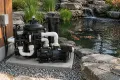
Many filters are rated according to pond volume, but these ratings often assume a relatively light fish load. Since koi produce significantly more waste than many ornamental pond fish, it is good practice to choose a filter rated for approximately 1.5 to 2 times your actual pond volume, or to select a system specifically rated for koi stocking levels.
A complete koi pond filtration system normally includes:
Mechanical filtration to remove solid waste, uneaten food, and other debris.
Biological filtration to convert ammonia and nitrite into less harmful nitrate.
UV clarification to control green water caused by free-floating algae.
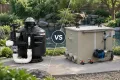
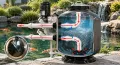
Bead filters are a popular choice for koi ponds because they can provide both mechanical and biological filtration in one compact system. They trap fine solids while providing a large surface area for beneficial bacteria. They can also be backwashed within a few minutes without requiring you to open the filter or handle dirty filter media. For koi ponds with a high fish load, choosing filtration designed specifically for this type of environment is particularly important. Aquabead bead filters are built for this type of high-load pond application and can be considered when sizing filtration for a new or upgraded koi pond.
As pond depth increases, removing waste that settles at the bottom becomes more difficult. A bottom drain installed at the lowest point of the pond addresses this problem by drawing settled solids directly toward the filtration system before they have time to break down and affect water quality. Bottom drains are strongly recommended for koi ponds deeper than approximately 3 feet. Many systems also incorporate an aeration dome connected to an air pump. This adds oxygen to the deepest section of the pond, improves water circulation, and helps move debris toward the drain.
For the best results, the pond floor should slope gently toward the bottom drain so that settled waste can move naturally toward the collection point. In larger ponds, two or more bottom drains may be necessary to provide adequate coverage across the entire floor area.
Many koi pond problems can be traced back to a small number of planning mistakes. These mistakes may not appear serious during construction, but they can become expensive and difficult to correct once the pond has been completed and filled.
Building a pond that is too shallow is one of the most common mistakes. A 2-foot-deep pond may look perfectly adequate when it is first constructed, but it can become excessively warm during summer, too cold during winter, and much easier for herons and raccoons to access. Adding depth during the initial construction process is considerably easier and less expensive than rebuilding a completed pond later.
Small koi can grow surprisingly quickly. A pond that seems spacious enough for ten 5-inch koi can become seriously overcrowded once those same fish reach 20 inches or more. For that reason, always plan the pond around the expected adult size of the koi rather than their current size. Doing so gives the fish enough room to grow while reducing the likelihood that you will need to relocate fish or rebuild the pond later.
It can be tempting to continue adding koi, especially when the fish are still small and there appears to be plenty of available space. However, as the fish grow, the increased waste load can quickly place pressure on the pond's filtration system. Overstocking can contribute to poor water quality, low oxygen levels, disease outbreaks, and constant maintenance. Follow the stocking guidelines for your pond volume, consider the adult size of your fish, and leave sufficient room for future growth.
A filter rated for your exact pond volume may not provide enough capacity for a koi pond, particularly when the system's rating assumes a light fish load. Undersized filtration can result in cloudy water, ammonia spikes, and the need for frequent cleaning. Instead, choose filtration based on both pond volume and fish load. It is also important to plan for the pond you expect to have in three to five years rather than focusing only on the number and size of koi you have today.
Plant shelves and shallow ledges can reduce the usable volume of the pond, collect debris, and provide predators with easier access to the fish. Keeping the main koi area deep and open is generally a better approach. If you want aquatic plants, consider placing them in a separate planted area or connected bog garden where they can be maintained without reducing the usable space available to your koi.
Depending on where you live, a pond deeper than approximately 18 to 24 inches may be subject to swimming-pool-style safety requirements. These requirements can include fencing, permits, or other protective measures. Before construction begins, check your local building and safety regulations, particularly if children live at or regularly visit the property. You should also contact your local utility locating service before digging to make sure you do not accidentally damage underground pipes, cables, or other utilities.
A healthy koi pond starts with getting the depth and overall size right from the beginning. Build to a minimum depth of 3 feet, with 4 to 6 feet being the more practical range for most ponds. Aim for at least 1,000 gallons of water and use roughly 250 gallons per adult koi as a starting guideline, while considering a larger allowance for bigger fish, heavier feeding, or warmer climates. Just as importantly, plan the pond around the adult size of your koi rather than their current size. Keep the main swimming area deep and open, minimize shallow shelves, provide adequate oxygenation, and check local building and safety requirements before construction begins.
Your pump and filtration system should also be matched to the pond's actual volume and fish load. Ideally, the full pond volume should pass through the filtration system once every 1 to 2 hours. A properly sized bead filter, supported by an appropriate bottom drain and circulation system, can help keep the water clear and stable as your koi continue to grow. If you are planning a new koi pond or upgrading an existing system, the Aquabead range of bead filters and pond filtration equipment can help you select filtration suited to your pond size and fish load.
1. How Deep Does a Koi Pond Need to Be in Winter?
In areas with freezing winters, a koi pond should be at least 4 feet deep, with the deepest section extending below the local frost line. This allows a layer of water near 39°F (4°C) to remain at the bottom where koi can rest safely during cold weather. It is also important to keep part of the pond surface open using a floating de-icer or aeration system. This provides a way for gases to escape rather than becoming trapped beneath a completely frozen surface.
2. Can Koi Live in a 2 Foot Deep Pond?
Koi can survive in a 2-foot-deep pond for a short period, but this depth is not suitable for their long-term health and comfort. Shallow water experiences greater temperature fluctuations, oxygen levels can fall during hot weather, and koi remain much more exposed to predators such as herons. For a permanent koi pond, a minimum depth of 3 feet is recommended, while 4 feet or more provides a better environment for healthy adult koi.
3. How Many Koi Can I Keep in a 1,000 Gallon Pond?
A 1,000-gallon pond can generally support around 3 to 4 adult koi when it has good filtration and receives regular maintenance. If you intend to keep more fish or larger varieties, a pond of 2,000 gallons or more provides a more suitable environment and greater water volume.
4. Is a Deeper Pond Better for Koi?
Up to a certain point, yes. Deeper water provides koi with more stable temperatures, greater protection from predators, and additional swimming space. However, the benefits become less significant beyond approximately 6 to 7 feet, while construction costs and maintenance challenges continue to increase. For most residential koi ponds, a depth of 4 to 6 feet offers a practical balance between fish health, stability, construction, and maintenance.
5. What Is the Best Shape for a Koi Pond?
Simple shapes such as rectangles, ovals, and gentle curves generally work well for koi ponds. These designs provide open swimming lanes, support more even water circulation, and reduce areas where debris can accumulate. Very narrow sections, tight corners, and complicated shapes can make water circulation, filtration, and cleaning more difficult. A straightforward pond design is therefore often easier to maintain while also providing a better swimming environment for koi.
6. How Big Should a Koi Pond Be for 5 Koi?
For 5 adult koi, plan for at least 1,250 to 1,500 gallons, with approximately 2,000 gallons being preferable if you want additional room for growth. A pond measuring around 10 feet long, 6 feet wide, and 4 feet deep holds roughly 1,800 gallons, making it a comfortable size for 5 koi when the pond has appropriately sized filtration and good water management.
7. How Much Does Pond Depth Affect Filtration?
Pond depth itself does not determine how much filtration you need. Instead, filtration requirements are primarily influenced by total pond volume and fish load. A deeper pond generally holds more water and may accommodate more fish, which can increase the filtration capacity required. Deeper ponds also benefit significantly from a bottom drain because waste naturally settles at the lowest point and needs to be removed efficiently.