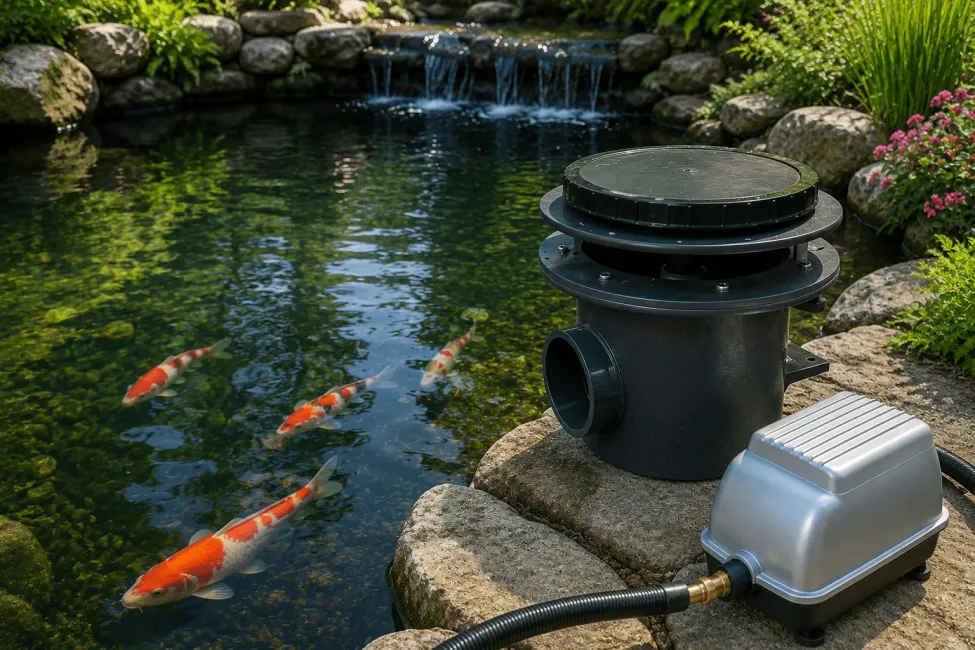
An aerated bottom drain can improve circulation at the deepest part of a koi pond. However, the air pump must deliver enough airflow where the diffuser actually sits. This is where many pond owners make a sizing mistake. When someone asks how much air pump for Rhino bottom drain, the answer cannot come from the pump's maximum rating alone. Pond depth, air-line resistance, diffuser resistance, and actual airflow all matter.
For the aerated Rhino II, published product specifications recommend approximately 1.5–3 CFM at the bottom drain depth. Other Rhino II listings give a broader recommended range of 1–3 CFM (28–85 LPM). Therefore, the key is choosing a pump that can provide the required airflow after accounting for the depth of your pond.
For the Rhino II Bottom Drain with Air Diffuser, a useful target is 1.5–3 CFM delivered at the actual depth of the drain. The Rhino II uses a 4-inch horizontal discharge and includes an air diffuser on the aerated model. That distinction—at depth—is extremely important. An air pump may advertise a certain maximum CFM rating. However, that number does not necessarily represent the airflow reaching a diffuser several feet underwater. As the diffuser gets deeper, the pump must work against greater water pressure. Therefore, pond owners should check the pump's performance curve rather than choosing equipment based only on its maximum airflow.
Air leaving a diffuser at the bottom of a pond must overcome the pressure created by the water above it. Therefore, an air pump operating a diffuser in a shallow pond faces less resistance than one operating several feet underwater. For example, two ponds could use the same Rhino II drain. However, one could have a drain four feet underwater and the other six feet underwater. The pumps may need different performance capabilities even though the bottom drains are identical. This is why the Rhino II recommendation specifically refers to airflow at the bottom drain depth. A pump rated for high airflow at little or no pressure may lose considerable performance as operating depth increases. Consequently, checking the manufacturer's airflow-versus-pressure chart is one of the most important sizing steps.
Pond volume matters when planning overall aeration. However, gallons alone should not determine the air pump used for an aerated bottom drain. For the Rhino II, start with the diffuser's airflow requirement.
Then consider:
This approach is more accurate than simply choosing an air pump because its packaging lists a particular pond capacity.
| Sizing Factor | What to Consider |
|---|---|
| Rhino II airflow | About 1.5–3 CFM at drain depth |
| Broader published range | 1–3 CFM / 28–85 LPM |
| Drain size | 4-inch horizontal discharge |
| Pond depth | Greater depth increases pressure |
| Air-line run | Longer or restrictive runs can reduce performance |
| Multiple drains | Total airflow demand increases |
| Pump selection | Check output at operating depth |
Published Rhino II information also identifies a direct connection into the air bladder. The aerated model incorporates a check valve designed to help prevent pond water from entering the air line.
An aerated bottom drain does more than simply produce bubbles. As air rises from the diffuser, it creates upward water movement. This circulation can complement the pond's overall bottom-drain system by encouraging water movement through the pond. However, too little airflow can result in weak aeration and less effective circulation around the drain area. This is why choosing an air pump with adequate performance at depth matters more than simply buying the smallest available unit. At the same time, bigger is not automatically better. The goal should be appropriate, controlled airflow that suits the diffuser and pond design.
The best pump technology depends partly on the pressure it must overcome. Linear diaphragm and linear piston pumps are commonly used for koi pond aeration because they can provide steady airflow. However, different models behave differently as pressure increases.
Therefore, pond owners should avoid assuming that one pump type automatically works at every depth. Instead, compare the pump manufacturer's performance curve with the required airflow.If the Rhino II needs roughly 1.5–3 CFM at its installed depth, the selected pump should still fall within the required range at that operating pressure. For deeper installations, choosing a pump designed to maintain adequate airflow under higher back pressure becomes increasingly important.
The air pump itself is only one part of the system. Air must travel from the pump through tubing or pipe before reaching the Rhino diffuser. A long or restrictive air line can create additional resistance. That means a correctly sized pump can still deliver disappointing results when the air-line installation restricts flow. Avoid unnecessarily narrow tubing, excessive fittings, sharp restrictions, and unnecessarily long runs where possible. More importantly, follow the pump manufacturer's requirements for line sizing.
The Rhino II itself uses a direct pipe connection into its air bladder rather than requiring an air line to be routed through the drain pipe.
This requires additional planning. Two aerated drains do not simply need a pump capable of reaching the correct depth. The pump must also provide enough total airflow for both diffusers at that operating pressure. For example, if each diffuser is intended to receive airflow within the recommended range, the system must supply both simultaneously. A manifold and individual flow controls may also be useful for balancing airflow between branches. Otherwise, air may favor the path with less resistance, leaving one diffuser noticeably stronger than the other.
A properly operating diffuser should create a consistent bubble pattern and noticeable upward water movement. Potential signs of insufficient airflow include weak bubbling, uneven diffuser performance, or airflow that becomes noticeably worse after changes to the air-line system. However, these symptoms do not automatically mean the pump is too small. A dirty diffuser, leaking air connection, blocked line, damaged component, or increased restriction can produce similar symptoms. Therefore, inspect the system before replacing the pump.
Pump sizing receives most of the attention, but diffuser condition also matters. As a diffuser ages or accumulates deposits, resistance can change. The pump may then need to work harder to push the same amount of air through it. Routine inspection is particularly useful when airflow has gradually declined despite no changes to the pump. The Rhino II's replaceable 12-inch air diffuser is available separately, which can be useful when servicing an existing installation.
No. The Rhino II Bottom Drain is available in both aerated and non-aerated versions, and only the aerated version requires an air pump for the diffuser. The Rhino II with an air bladder diffuser is designed to release air from the bottom of the pond, with published specifications recommending approximately 1–3 CFM of airflow.
The non-aerated Rhino II does not include this air diffuser, so there is no need to connect an air pump specifically to the bottom drain. It can still perform its primary job of moving pond water and settled debris into the filtration system without aeration.
For pond owners choosing between the two versions, the decision depends on the overall pond design and aeration requirements. If you want aeration and additional water movement from the bottom of the pond, the aerated Rhino II may be the more suitable option. If aeration is already provided elsewhere or isn't required at the drain, the non-aerated version can be used without an air pump.
So, how much air pump for Rhino bottom drain should a pond owner use? For an aerated Rhino II, start with approximately 1.5–3 CFM at the actual bottom drain depth. Then account for pond depth, air-line resistance, diffuser condition, and any additional drains sharing the pump. The biggest mistake is selecting an air pump only from its maximum advertised CFM.
Instead, check how much air the pump can actually deliver against the pressure created by your installation. This helps provide reliable aeration without unnecessarily oversizing the system.
The Rhino II Bottom Drain from AquaBead is designed for permanent pond installations and is available with an aerated configuration. When paired with properly sized aeration, it can become an important part of a well-planned koi pond circulation system.
1. How much CFM does a Rhino II bottom drain need?
The aerated Rhino II is commonly specified at approximately 1.5–3 CFM at the bottom drain depth. Some product listings state a recommended range of 1–3 CFM.
2. Why does pond depth matter when choosing an air pump?
Greater water depth increases the pressure the pump must overcome. As a result, actual airflow can be lower than the pump's maximum advertised airflow.
3. Can one air pump operate two Rhino II bottom drains?
Potentially, provided the pump supplies enough airflow for both diffusers at their operating depth and the air distribution can be properly balanced.
4. Does every Rhino II bottom drain need an air pump?
No. The Rhino II is available with and without an air diffuser. The non-aerated version does not require an air pump for the drain itself.
5. Should I buy a larger air pump for a deeper pond?
Possibly. The important measurement is the pump's delivered airflow at the required operating pressure, rather than its maximum open-flow rating.
6. What should I check if my Rhino diffuser has weak airflow?
Check the pump performance, air line, connections, diffuser condition, and restrictions before assuming the pump needs replacement.